


Однопозиционная экономичная ручная полировальная машина: руководство по эксплуатации, график технического обслуживания и рецепты финишной обработки.
Серия моделей: SPM-ECO-1000 • Экологичная полировальная станция с системой контроля пыли • Оптическая и аппаратная версия
ОнОднопозиционная экологичная ручная полировальная машина JINTAIJIN SPM-ECO-1000Это экологичная высокоточная полировальная станция, разработанная для придания глянцевого блеска очкам из ацетата целлюлозы, оптическим деталям, ювелирным изделиям, корпусам часов и высококачественной фурнитуре. Шпиндель с бесступенчатой регулировкой частоты 1,5 кВт (0–3600 об/мин), высокоскоростная система пылеудаления с отрицательным давлением (1200–1500 м³/ч), многокамерная полиэфирная фильтрация с размером пор 5–10 мкм и выдвижной ящик для сбора пыли объемом 15 л обеспечивают превосходный блеск поверхности без образования пыли в воздухе.


Данное руководство содержит технические характеристики изделия, описание механической конструкции, основные правила техники безопасности, инструкции по установке и предварительной наладке, полный перечень стандартных операционных процедур (СОП), инструкции по пылефильтрации и работе вибрационного устройства, профилактическое техническое обслуживание, поиск и устранение неисправностей, а также информацию о заводских запасных частях. Если вы сначала сравниваете варианты оборудования, ознакомьтесь с нашим руководством.коллекция отделочных машинили более широкийАссортимент шлифовальных и чистовых станков.
Скачать паспорт безопасности материала (MSDS) (на английском языке, оригинальный документ).Паспорт безопасности материала для абразивных полировальных материалов на основе смолы JINTAIJIN — предоставляется в точном соответствии с оригиналом, без изменений.
Скачать паспорт безопасности материала (английский) — PDFОбзор оборудования и его возможностей.SPM-ECO-1000 объединяет механику шлифовального шпинделя с высоким крутящим моментом, автономный пылеотсос и высокоэффективную фильтрующую матрицу для промышленной полировки поверхностей. Оснащенный бесступенчатым частотно-регулируемым приводом шпинделя, вытяжным колпаком с отрицательным давлением, механическим рычагом пылеотделителя и герметичным 15-литровым отсеком для сбора пыли, он подходит для обработки оправ очков из ацетата/пропионата, оптических деталей, ювелирных изделий, корпусов часов и тонкой отделки фурнитуры.
1. Технические параметры и характеристики
В таблице ниже приведена стандартная техническая конфигурация однопозиционного экономичного ручного полировального станка SPM-ECO-1000.
| Технические параметры | Инженерная ценность / Диапазон | Технические характеристики |
| Мощность шпиндельного двигателя | 1,5 кВт / 2,0 л.с. (непрерывный режим работы S1) | Высокомоментный асинхронный двигатель с частотно-регулируемым приводом. |
| Диапазон скорости вращения шпинделя | 0–3600 об/мин (плавная регулировка) | Цифровой индикатор оборотов в минуту и прецизионный потенциометр. |
| Воздуходувка для пылеудаления | 0,75 кВт (центробежный компрессор высокого давления с обратным потоком воздуха) | Расход воздуха: 1200–1500 м³/ч (700–880 CFM) |
| Скорость всасывания на входе | ≥ 18,0 м/с в области извлекающего горла | Прямое извлечение частиц без утечки из окружающей среды |
| Степень фильтрации и фильтрующие материалы | Полиэстерная ткань, прошитая иглой, 5–10 мкм | Эффективность отделения пыли ≥ 98,5% (многокарманная система) |
| Производительность пылеулавливания | Выдвижной стальной ящик объемом 15 литров | Двойные быстросъемные зажимные фиксаторы и уплотнение из EPDM |
| Ассортимент полировальных кругов | Ø150 мм – Ø250 мм (диаметр 6–10 дюймов) | Диаметр отверстия для коронки: Ø16 мм или Ø25 мм |
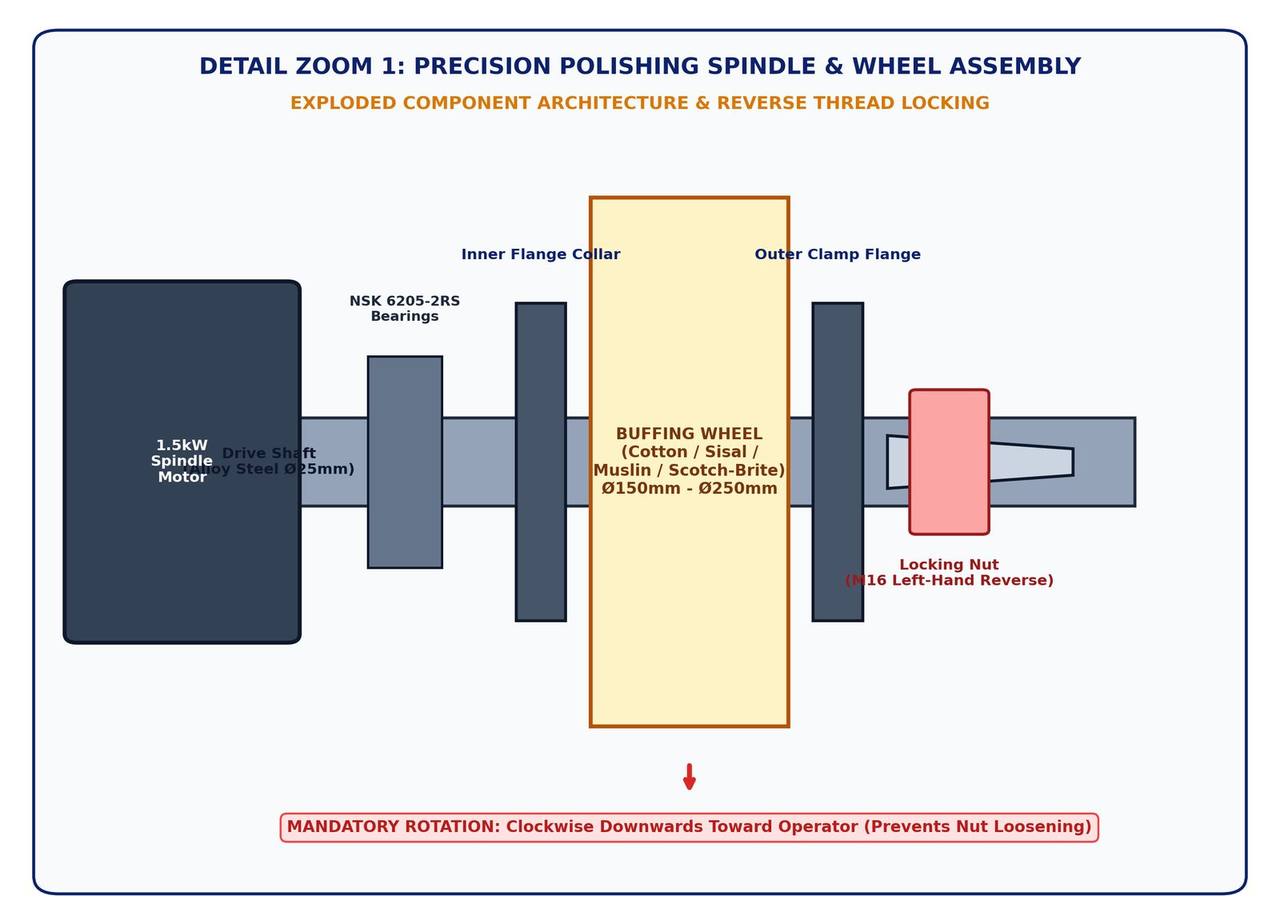
| Технические характеристики шпиндельного вала | Высокоточная цельнометаллическая легированная сталь Ø25 мм | Резьба M16 левосторонняя реверсивная; биение ≤ 0,02 мм |
| Освещение рабочего места | Промышленная светодиодная балка без теней, 24 Вт | Освещенность ≥ 1200 люкс на рабочей поверхности стола. |
| Источник питания и напряжение | 220 В, 1 фаза / 380 В, 3 фазы, 50/60 Гц | Сопротивление заземления корпуса строго |
| Акустический шумовой рейтинг | Уровень шума ≤ 72 дБ(А) на расстоянии оператора 1,0 м. | Соответствует стандартам ISO 11202 и OSHA 1910.95. |
| Габариты / Вес машины | 850 × 750 × 1350 мм (Д×Ш×В) | 115 кг | Прочная сварная рама + 4 регулируемые ножки |
2. Механическая архитектура и идентификация подсистем
Станок объединяет шлифовальный шпиндель, систему отвода пыли под отрицательным давлением, многокамерную систему фильтрации и герметичный отсек для сбора пыли в единое пылезащитное рабочее место. На приведенной ниже схеме указаны все основные конструктивные элементы и их точные технические термины на английском языке.
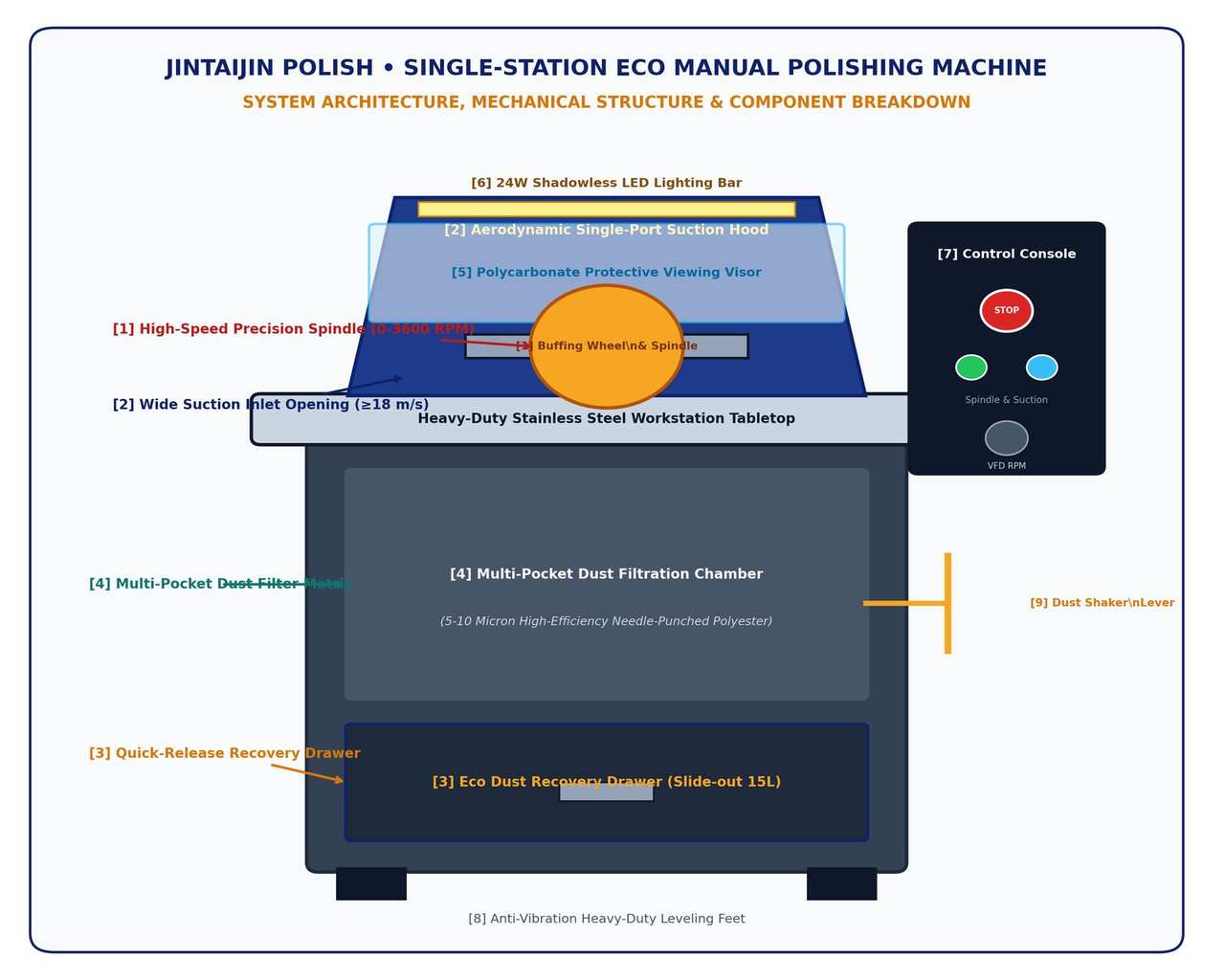
2.1. Разбор основных подсистем
| # | Компонент | Функциональное описание и операционная роль |
| 1 | Прецизионный шпиндельный вал | Цельный вал из сплава диаметром 25 мм с гайкой с обратной резьбой M16 и зажимными фланцами. |
| 2 | Аэродинамический вытяжной колпак | Широкий воздухозаборник с отрицательным давлением отводит пыль непосредственно за колесо. |
| 3 | Выдвижной ящик для сбора пыли | Выдвижной стальной контейнер объемом 15 литров с двумя быстросъемными герметичными защелками. |
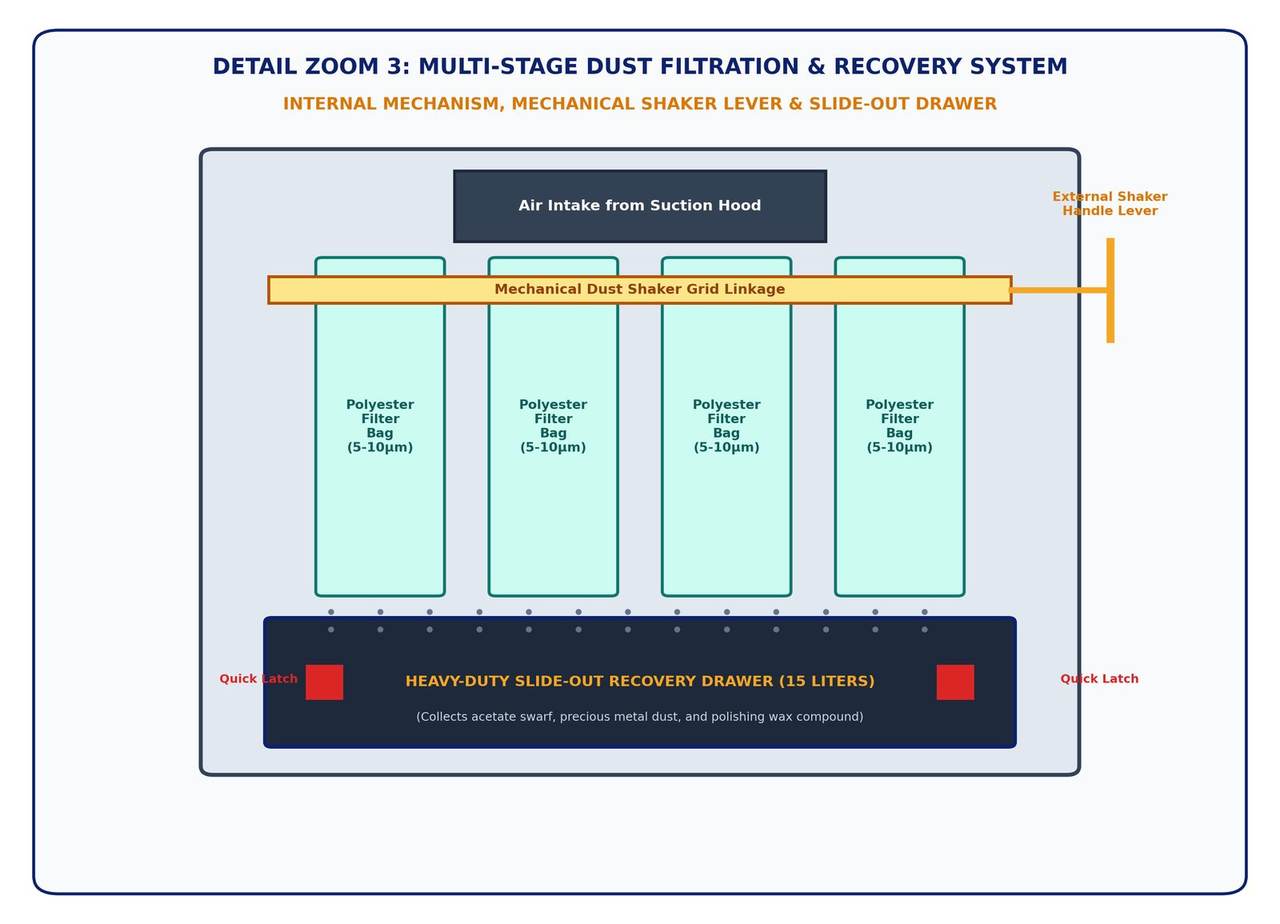
| 4 | Многокарманная фильтрующая камера | В комплект входят 4 фильтрующих мешка из полиэстеровой ткани (5–10 мкм) с коэффициентом разделения ≥98,5%. |
| 5 | Защитный козырек из поликарбоната | Откидной, ударопрочный прозрачный защитный экран предохраняет оператора от разлетающихся стружек. |
| 6 | Бестеневая светодиодная лампа мощностью 24 Вт | Светодиодная линейка дневного спектра, освещающая плоскость контакта при полировке (≥1200 люкс). |
| 7 | Панель управления | Передняя панель с кнопкой аварийной остановки, переключателями питания/всасывания/освещения и регулятором оборотов частотного преобразователя. |
| 8 | Выравнивающие опорные стойки | Четыре регулируемые прочные антивибрационные ножки M16 с резиновыми амортизирующими накладками. |
| 9 | Рычаг пылеотделителя | Внешний боковой рычаг, соединенный с внутренней решеткой, предназначен для перемещения фильтрационного осадка в выдвижной ящик. |


3. Essential Safety Regulations & Hazard Controls
DANGER — severe mechanical entanglement hazard: NO GLOVES.STRICT PROHIBITION OF GLOVES: NEVER wear gloves (cotton, leather, rubber, or nitrile), loose clothing, neckties, rings, or wrist jewelry during polishing spindle operation. The high-speed rotating spindle and cotton buff will instantly grab textile fibers and drag the operator’s hands into the arbor within milliseconds. Long hair MUST be securely bound in a protective cap.
3.1 Mandatory Personal Protective Equipment (PPE)
- Eye & Face Protection:ANSI Z87.1 / EN 166 Grade B certified safety goggles or face shield.
- Respiratory Protection:NIOSH N95 or EN 149 FFP2 particulate respirator for fine dust.
- Hearing Protection:Industrial earplugs or earmuffs (NRR ≥ 22 dB) during extended shifts.
- Apparel & Footwear:Snug workwear with elastic cuffs; steel-toe anti-slip safety shoes.
3.2 Combustible Dust & Static Grounding Protocols
- Grounding:Cellulose acetate, acrylic, and polishing wax generate combustible fine dust. Ensure chassis grounding resistance is strictly
- Spark Control:NEVER polish spark-producing ferrous metals (steel/iron) without prior complete cleanout of the filtration chamber and dust drawer.
4. Installation & Pre-Commissioning
1. Leveling.
Place machine on a level concrete floor. Adjust 4 leveling footpads until the tabletop is level in all axes, then lock jam nuts.
2. Electrical.
Connect to dedicated branch circuit (16A breaker for 220V 1-Phase; 10A breaker for 380V 3-Phase). Secure PE ground wire (
3. Rotation.
Buffing wheel MUST rotate clockwise downward toward operator. If rotation is reversed on 3-phase units, swap incoming lines L1 and L2.
4. Wheel Mounting.
Slide inner flange onto shaft → Mount wheel → Slide outer flange → Hand-thread M16 reverse nut → Tighten firmly with spanner (45–50 N·m).
5. Standard Operating Procedures (SOP) & Finishing
Follow this streamlined 4-stage workflow to guarantee repeatable, mirror-grade finishing and ensure maximum operator safety.
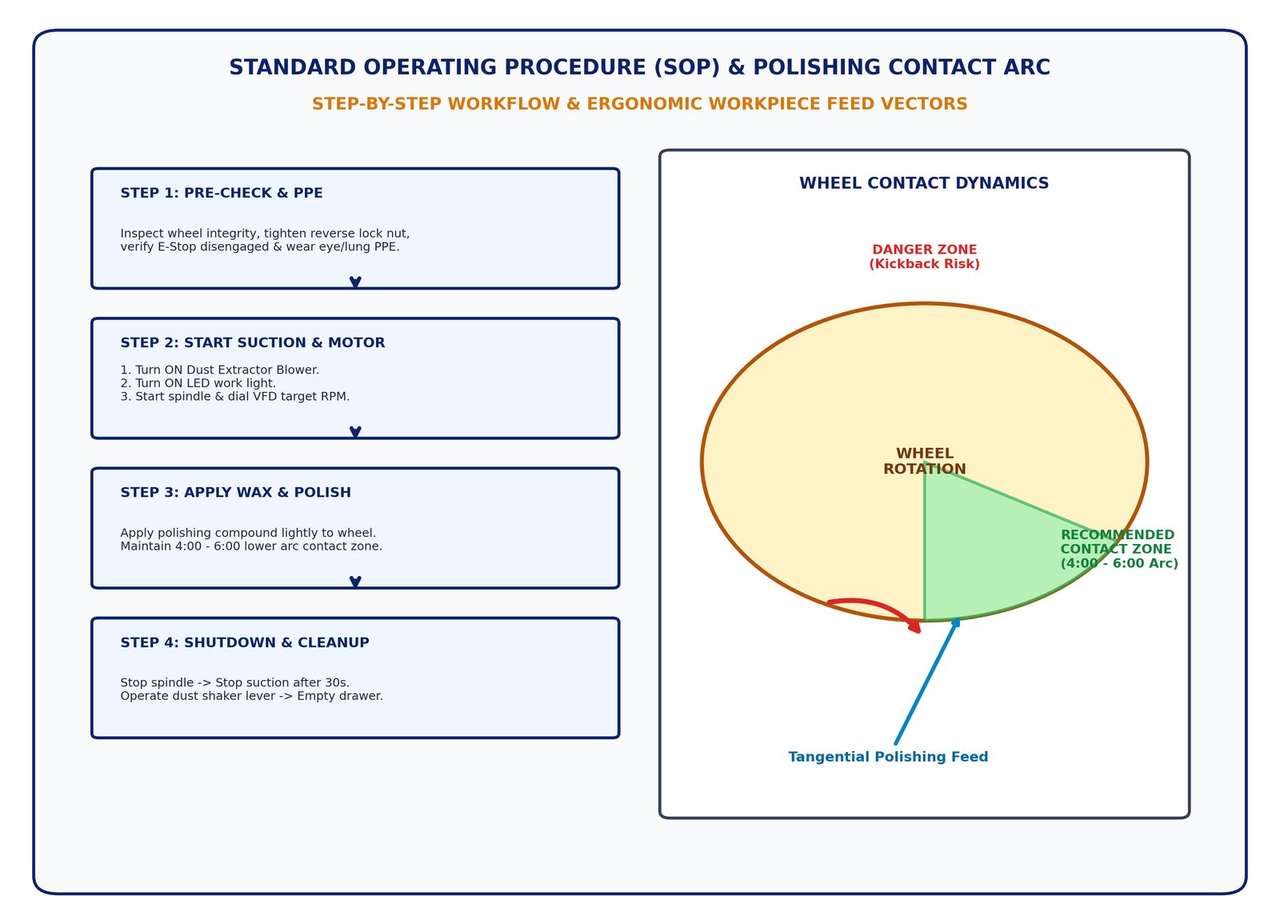
5.1 Daily Startup Sequence
1. Power.
Turn ON Main Power isolator switch (green indicator illuminates).
2. Suction.
Press DUST SUCTION button and verify strong negative air draw at the hood throat.
3. Lighting.
Turn ON LED Work Light switch to illuminate the contact plane.
4. Spindle.
Press SPINDLE START and dial VFD speed potentiometer to target RPM (2,000–2,400 RPM for acetate; 3,000 RPM for metal).
5.2 Workpiece Contact Arc & Kickback Prevention
WARNING — kickback danger & safe contact zone.MANDATORY CONTACT ZONE (4:00 TO 6:00 ARC): Always present the workpiece against the LOWER QUADRANT of the wheel (between 4:00 and 6:00). NEVER polish above the centerline (12:00 to 2:00 zone) — the wheel will violently snatch and throw the workpiece forward (kickback hazard). Maintain light, steady, tangential pressure.
5.3 Eyewear & Precision Hardware 3-Stage Finishing Protocol
| Process Stage | Recommended Wheel | Compound | Speed | Surface Objective |
| Stage 1 (Coarse Cut & Deburr) | Spiral cotton / sisal wheel | Brown Tripoli compound | 2,200–2,400 RPM | Removes CNC milling tool marks and burrs. |
| Stage 2 (Smooth & Level) | Yellow treated cotton wheel | Green Chromium Oxide compound | 2,000–2,200 RPM | Buffs frame bevels and bridge into a smooth satin finish. |
| Stage 3 (Mirror Finish) | Soft unstitched muslin wheel | Blue Luster or White Diamond wax | 1,800–2,000 RPM | Polish with light touch for optical mirror gloss. |
Compound tip — dedicated wheels per stage.Always use a dedicated buffing wheel per compound grade. A wheel contaminated with coarse Tripoli will transfer swirl marks into the final mirror stage. Rake wheels clean between batches.
5.4 End-of-Shift Shutdown Routine
Stop spindle → Run suction for 30s to purge ductwork → Turn OFF suction, light, and power → Pump dust shaker lever 6–8 times into drawer.
6. Dust Filtration, Shaker Operation & Recovery
1. Recovery Drawer — empty daily.
Turn OFF machine. Release dual quick-latches, slide 15L drawer out, empty swarf into waste/recycling bin, wipe EPDM gasket clean, and clamp latches airtight.
2. Shaker Agitation — every 4 hours.
With suction fan completely OFF, grasp external side shaker lever and pump vigorously 6–10 times. Internal grid shakes caked dust down into the drawer.
3. Swarf Recovery — precious metal reclamation.
The sealed collection drawer enables 100% dry reclamation of gold, silver, brass, and titanium polishing swarf without slurry contamination.
7. Preventive Maintenance & Troubleshooting
7.1 Preventive Maintenance Schedule
| Maintenance Frequency | Mandatory Inspection & Service Procedures |
| Daily (Every Shift) | Empty 15L recovery drawer; clean PC visor; pump filter shaker 6–8 times; check wheel wear. |
| Weekly (40 Hours) | Inspect spindle arbor runout; check drive belt tension; inspect EPDM drawer gasket seal. |
| Monthly (160 Hours) | Inspect filter bags for tears or caking; verify ground bond ( |
| Semi-Annually (1,000 Hours) | Lubricate spindle bearings with 3–5g high-speed grease (Mobil Polyrex EM); check VFD. |
| Annually (2,000 Hours) | Replace complete set of multi-pocket filter bags (SPM-FLT-1004); inspect motor dynamic balance. |
7.2 Comprehensive Troubleshooting Matrix
| Fault Symptom | Probable Root Causes | Corrective Action & Resolution |
| Machine will not power ON | Main breaker tripped; E-Stop locked down; blown fuse. | Reset breaker; rotate E-Stop clockwise to release; check fuse. |
| Motor hums but will not spin | Phase loss on power line; VFD fault; arbor jam. | Verify incoming line voltages; check VFD code; clear arbor. |
| Excessive machine vibration | Unbalanced buffing wheel; loose M16 lock nut. | Dress or replace buffing wheel; tighten M16 nut to 45 N·m. |
| Weak suction airflow at hood | Filter bags caked; drawer unlatched; duct clog. | Pump shaker lever 10 times; clamp drawer tight; clear duct. |
| Workpiece burning (Acetate) | RPM too high; excessive pressure; dry buffing wheel. | Reduce speed to 2,000–2,400 RPM; use light touch; apply wax. |
| Swirl marks / haze on surface | Wheel contaminated with coarse compound/grit. | Rake wheel clean; use dedicated buffing wheel per compound. |
| Acoustic squeal / grinding noise | Dry spindle bearings; loose drive belt rubbing frame. | Grease bearings with Mobil Polyrex EM; adjust belt tension. |
8. Spare Parts & Factory Service Contact
8.1 Genuine Factory Spare Parts Catalog
| Part Description & Specifications | Factory Part No. | Application & Replacement Notes |
| Multi-Pocket Polyester Filter Bag Set (4 Pockets, 5–10µm) | SPM-FLT-1004 | Replace every 12–18 months depending on duty cycle |
| Polycarbonate Safety Visor Shield (3mm High-Impact PC) | SPM-SHD-PC01 | Pre-drilled mounting holes with hinge hardware |
| NSK High-Speed Spindle Deep Groove Ball Bearings (Pair) | BRG-6205-2RS | Pre-greased, double rubber sealed (25×52×15 mm) |
| Over-Center Toggle Clamps with Rubber Spindle Pad | CLP-TGL-GH403 | Heavy-duty zinc-plated steel for recovery drawer |
| M16 Left-Hand Reverse Thread Hex Nut & Clamping Flanges | NUT-M16-LH02 | Precision balanced alloy steel hardware set |
| Mushroom Head Twist-to-Reset Emergency Stop Pushbutton | SW-ESTOP-XB2 | Standard 22mm panel mount, 1NC contact block |
| 24W Industrial Shadowless Daylight LED Tube Luminaire | LED-T8-24W-6.5K | 6500K Color Temperature, IP54 dust resistant |
| EPDM Foam Airtight Recovery Drawer Sealing Gasket | GSK-EPDM-1505 | Self-adhesive oil and wax resistant sponge rubber |
8.2 Гарантия производителя и официальная контактная информация
На систему SPM-ECO-1000 распространяется гарантия.Гарантия производителя 12 месяцевВключает в себя двигатель, вентилятор, частотно-регулируемый привод и несущий каркас в условиях нормальной промышленной эксплуатации. Для получения технической помощи, разработки индивидуальных процессов полировки, замены шлифовальных кругов или запросов на запасные части, свяжитесь с нашей инженерной службой поддержки. Мы также предлагаем OEM/ODM-заказы и поставку расходных материалов для всего ассортимента однопозиционных полировальных станков — ознакомьтесь с нашим ассортиментом.отделочные составыирасходные материалыкатегории для восков, составов и полировальных кругов, подобранных для конкретного этапа работы.
Вам нужна пылезащитная полировальная станция для обработки деталей?
Пришлите информацию о материале детали, ее размере, текущем состоянии поверхности и желаемом качестве отделки. Наша команда специалистов по финишной обработке порекомендует подходящее оборудование, шлифовальные круги, компаунд и методику тестирования.
Свяжитесь с нашей командой отделочниковJINTAIJIN POLISH MACHINERY CO., LTD. • Официальный сайт:www.surface-polish.com | Адрес электронной почты службы поддержки:info@surface-polish.com | Сертификаты ISO 9001:2015 и CE
 +86-592-2381506


 Поддержка сети IPv6